
Background
One of the world's leading medical device companies relies on teams whose expertise has been built over years of product development, regulatory work, and day-to-day operations. Much of that expertise was never formally documented. Instead, it lived as "tribal knowledge," held by individual team members or buried across scattered source documents.
The company partnered with NyquistAI to turn this unstructured knowledge into a reliable, accessible resource that would stay useful as people, products, and documents change.
Challenge
Relying on tribal knowledge created real risk to knowledge continuity and organizational resilience. When critical know-how depends on specific individuals or hard-to-find files, onboarding slows, decisions take longer, and valuable context can be lost when people change roles.
A traditional wiki would not solve the problem on its own. The team needed a knowledge base that could be built from existing documents without massive manual effort, stay accurate as those documents evolved, preserve edits from subject-matter experts, and fit into the tools employees already use instead of becoming one more destination to check.
Solution
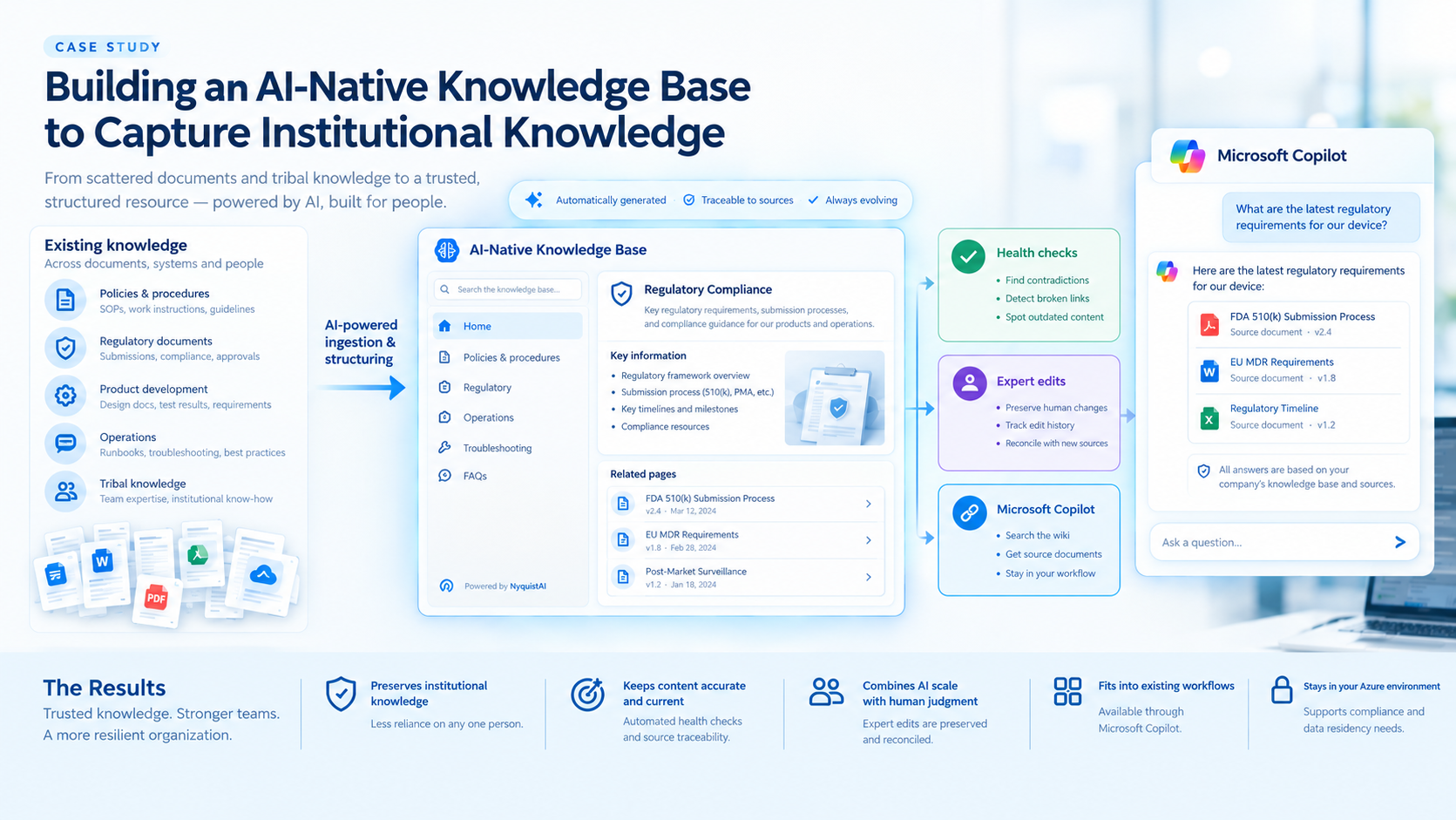
NyquistAI designed and built an AI-native knowledge base that automatically and incrementally generates a structured, browsable wiki from the company's existing documents, with every page traceable back to its sources. The system runs entirely within the client's Azure environment.
To keep the wiki trustworthy, scheduled health checks look for contradictions between pages or between a page and its sources, broken links to documents that have moved or been deleted, and content that has fallen out of date. Flagged issues appear on a health dashboard and are routed to experts for review.
Subject-matter experts can edit any generated page. A change-record mechanism tracks their edits separately from AI-generated content, so future updates respect human contributions instead of silently overwriting them.
Finally, the knowledge base connects to Microsoft Copilot through a Model Context Protocol (MCP) server. Employees can search the wiki and retrieve the underlying source documents directly from Copilot, without leaving their everyday workflow.
Benefits
The platform converts scattered tribal knowledge into a living, structured resource, reducing the company's dependence on any one person's memory. Automated health checks keep content accurate and current, so teams can trust what they find. Expert edits are preserved and reconciled with new source material, combining AI scale with human judgment. And because the knowledge base is available through Microsoft Copilot, employees get answers in the tools they already use, with source documents a click away. With all data kept inside the company's own Azure environment, the architecture also supports its compliance and data residency needs.